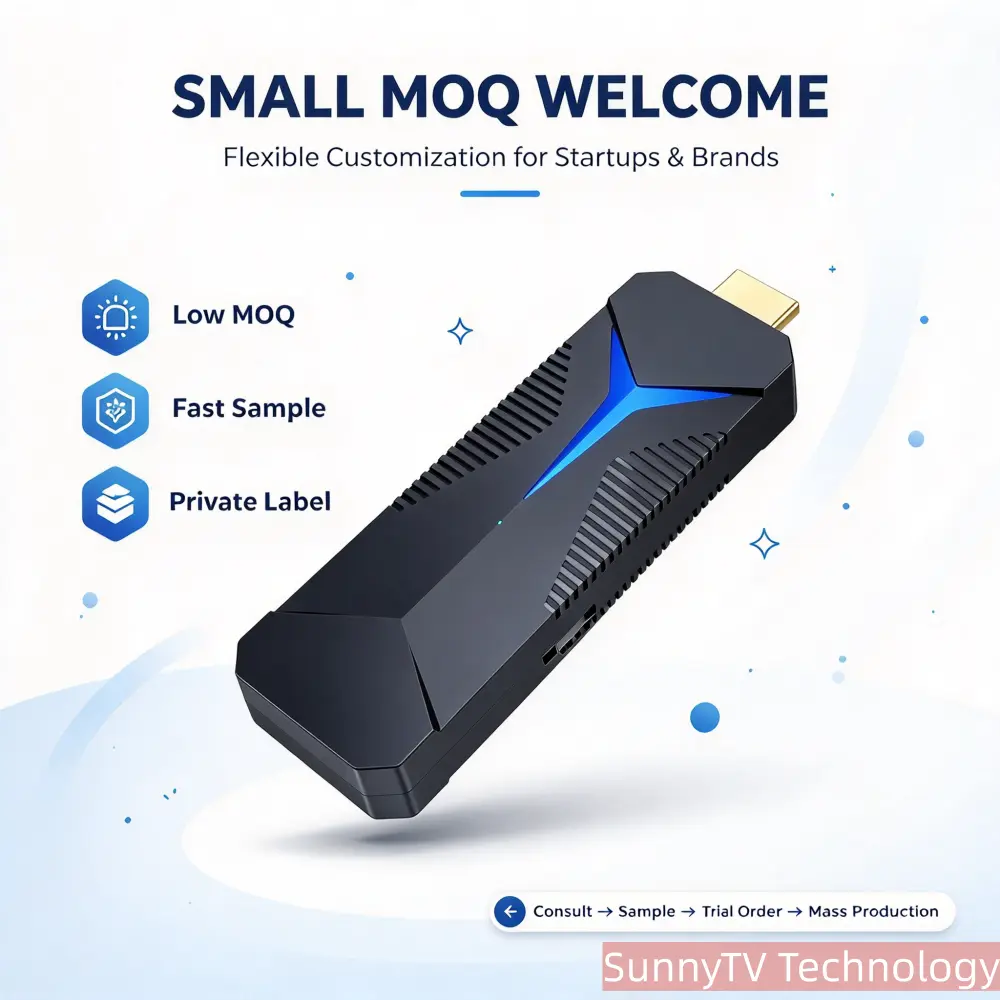
What a Real Android TV Stick OEM Factory Should Provide Before You Pay a Deposit
Paying a deposit is the point at which a sourcing negotiation becomes a commercial commitment. Before that moment, both parties are exchanging information with limited accountability. After it, money has changed hands, production slots are being reserved, and the buyer's leverage decreases considerably. For B2B buyers sourcing an OEM Android TV Stick, the period before deposit is therefore the most valuable window for due diligence.
The challenge is knowing what to ask for. Many buyers focus on unit price and lead time, which are important but far from sufficient. A genuine manufacturing partner should be able to provide a defined set of documents, samples, and verifiable information that demonstrate capability, quality discipline, and operational legitimacy. A trading intermediary or an under-equipped workshop will typically struggle to produce these items, and that difficulty is itself a useful signal.
This article outlines what buyers should expect from a real Android TV Stick OEM factory before releasing a deposit. It covers sample protocols, technical documentation, quality evidence, certification status, customization deliverables, and commercial terms. The objective is not to make sourcing adversarial, but to establish the information baseline that protects both parties and reduces the risk of disputes later in the project.
Why the Pre-Deposit Stage Matters More Than Buyers Realise
In electronics manufacturing, problems that surface after deposit are expensive to correct. Tooling may already be cut, components may already be ordered, and production schedules may already be committed. A buyer who discovers a capability gap at that stage faces limited options: accept a compromised product, absorb additional costs, or abandon the deposit and restart sourcing.
The pre-deposit stage is where these risks can be identified at minimal cost. Requesting documentation and samples is a normal part of professional sourcing, and legitimate manufacturers expect it. Reluctance to provide standard information, or repeated deflection of specific technical questions, should be treated as a warning sign rather than a personality quirk.
Basic Company and Factory Verification
Before technical discussions begin, buyers should confirm that the supplier is a manufacturer rather than a trading company presenting itself as a factory. This distinction affects pricing transparency, customization capability, and accountability.
Business License and Legal Entity
A legitimate factory should provide a business license showing a registered entity name, registration number, registered address, and business scope. Buyers should verify that the business scope includes manufacturing activities rather than only trading or technology services. The registered entity name should match the name on quotations, proforma invoices, and bank account details.
Factory Address and Production Facility
The production address should be consistent across documents. Buyers should request a factory video walkthrough or, where feasible, arrange a third-party inspection. Requests to visit or inspect should be welcomed by a genuine manufacturer. Hesitation, last-minute rescheduling, or an offer to meet at an office instead of the factory warrants further scrutiny.
Bank Account Verification
Payment should be made to a company account matching the registered entity, not to an individual's personal account. Requests to route payment through a third-party or personal account are a significant risk indicator in cross-border sourcing.
Sample Protocol: What to Request and How to Evaluate
Samples are the most direct form of evidence. However, the way a supplier handles sampling reveals as much as the sample itself.
Production-Representative Samples
Buyers should confirm that samples are drawn from production or are representative of production units, not hand-built engineering samples. Hand-built samples often perform better than mass production units because they receive individual attention. A manufacturer confident in its process will have no difficulty providing production-representative units.
Multiple Units for Consistency Testing
Requesting two or three units allows buyers to assess consistency. Variations in enclosure fit, port alignment, boot behaviour, wireless performance, or thermal behaviour across units indicate process variability that will worsen at scale.
Sample Evaluation Checklist
The following areas should be tested systematically on received samples:
- Boot time and system stability under extended operation
- Wireless performance at 2.4GHz and 5GHz, including throughput and range
- Bluetooth pairing and connection stability
- Video playback across common resolutions and codecs
- HDMI output stability and handshake behaviour with different displays
- Thermal behaviour under sustained load
- Remote control responsiveness and range
- Enclosure fit, finish, and structural rigidity
- Port alignment and mechanical tolerances
- Power consumption in idle and load conditions
Documenting sample evaluation results provides an objective baseline for comparing suppliers and for referencing later if production quality diverges from the approved sample.
Technical Documentation Expected from a Real Factory
A manufacturer with genuine engineering capability maintains technical documentation as part of normal operations. Buyers should request the following items where relevant to the product.
Hardware Specification Sheet
A complete specification sheet should detail the SoC model, CPU and GPU configuration, RAM type and capacity, storage type and capacity, wireless module model, Ethernet configuration where applicable, USB and other interface specifications, power input requirements, and operating temperature range. Vague descriptions such as "high-performance chipset" are not acceptable for commercial procurement.
Block Diagram or System Architecture Overview
Where confidentiality permits, a block diagram demonstrates that the manufacturer understands its own design. This is particularly relevant for customized products where the buyer needs to understand how subsystems interact.
Firmware Version and Software Stack Information
Buyers should receive the Android version, build number, kernel version, and a list of preinstalled applications. For customized firmware, the development plan, feature list, and acceptance criteria should be documented before deposit.
Power Adapter and Accessory Specifications
Accessory quality is frequently overlooked and frequently problematic. Buyers should request specifications for the power adapter, HDMI cable if included, remote control, and any other bundled items, along with certification status for each.
Quality Evidence and Testing Reports
Quality claims are easy to make and difficult to verify. Documentation provides the necessary evidence.
| Document | What It Demonstrates | Buyer Action |
|---|---|---|
| Certificate of Analysis | Lot-specific test results | Confirm relevance to the offered product |
| Reliability test report | Drop, vibration, aging, thermal cycling | Check test conditions and pass criteria |
| Aging and burn-in records | Early failure screening | Confirm duration and pass rate thresholds |
| Incoming inspection records | Component authenticity controls | Verify critical components are covered |
| Defect rate statistics | Process stability over time | Request trend data, not a single figure |
Buyers should also ask about functional test coverage. A credible factory will describe specific test stations, what is tested at each, and how failures are handled.
Certification Status and Compliance Documentation
An OEM Android TV Stick destined for international markets requires compliance documentation appropriate to the destination. Before paying a deposit, buyers should clarify which certifications already exist for the platform and which must be obtained for the specific product configuration.
Common requirements include CE marking for the European Union, FCC certification for the United States, UKCA marking for the United Kingdom, RoHS and REACH compliance, and wireless certifications such as those administered by the Wi-Fi Alliance and Bluetooth SIG. Buyers should request copies of existing certificates and confirm that the certificate holder and product model match the offered configuration. A certificate issued for a different model or a different factory is not transferable evidence of compliance.
Where certification is not yet in place, the manufacturer should provide a clear plan including the test laboratory to be used, estimated timeline, cost allocation, and responsibility for sample submission.
Customization Deliverables for OEM and ODM Projects
For buyers requesting OEM Android TV Stick production with custom elements, the pre-deposit stage should produce concrete deliverables rather than verbal commitments.
Customization Scope Document
A written scope should specify exactly what will be customized: enclosure appearance and logo application, packaging design and printing, boot logo and animation, launcher or user interface modifications, preinstalled applications, default settings, and any hardware changes. Each item should have an acceptance criterion.
Design Mockups and Approvals
Packaging and enclosure artwork should be approved through mockups or physical proofs before deposit. Digital files alone are insufficient for colour accuracy and print quality assessment.
Software Development Plan
For firmware customization, the manufacturer should provide a development schedule with defined milestones, sample delivery points for review, and a testing protocol. Buyers should confirm who owns the resulting firmware and whether source access or escrow arrangements are available.
Tooling and Mold Arrangements
Where custom tooling is required, the buyer should receive written terms covering tooling cost, ownership, amortization, storage, maintenance responsibility, and what happens to the tooling if the relationship ends.
Commercial Terms to Confirm Before Deposit
Commercial clarity protects both parties. The following terms should be documented in a proforma invoice or purchase agreement before payment.
- Unit price with clear Incoterms and currency
- Payment schedule, deposit percentage, and balance terms
- Order quantity and any volume pricing tiers
- Production lead time measured from deposit and material readiness
- Shipping method, port of departure, and freight responsibility
- Packaging specification including carton dimensions, weight, and marking
- Warranty period and scope of coverage
- Defective unit handling policy and replacement terms
- Quality inspection rights and third-party inspection allowance
- Handling of component cost fluctuations during the order period
Buyers should be cautious of suppliers who resist documenting these terms. A factory with established export operations will have standard templates and will expect such terms to be discussed.
Red Flags That Justify Delaying Payment
Certain patterns indicate elevated risk and justify pausing the transaction until clarified.
- Inability or unwillingness to provide a business license or factory address
- Requests for payment to a personal or third-party account
- Refusal to provide production-representative samples
- Specification sheets with vague or missing technical details
- Certificates that do not match the offered model or manufacturer
- Pressure to pay immediately with limited time for evaluation
- Unwillingness to document customization scope or acceptance criteria
- Inconsistent information between sales representatives
- No clear explanation of who performs final quality inspection
None of these indicators is conclusive on its own. Taken together, however, they suggest a supplier that may not be able to deliver reliably at commercial volumes.
Evaluating Software Capability Specifically
Android TV Stick products live or die on software quality. Before deposit, buyers should probe software capability with specific questions rather than general ones.
Relevant questions include which Android version the platform runs, whether the build is based on a vendor BSP or a custom fork, how OTA updates are implemented and tested, whether DRM integration for streaming platforms is supported, how preinstalled applications are managed, and what development resources are available for customization requests. A manufacturer with in-house software capability will answer these questions directly and in technical detail.
Buyers should also ask how firmware issues are handled post-shipment. A clear process for bug reporting, root cause analysis, and firmware updates is essential for products deployed in the field.
Preparing Your Own Due Diligence Checklist
Standardising the information requested from each candidate supplier makes comparison objective and reduces the influence of sales presentation quality. A practical checklist should cover company verification, sample protocol, technical documentation, quality evidence, certification status, customization deliverables, commercial terms, and software capability.
Buyers who apply the same checklist across multiple suppliers quickly develop a clear picture of which candidates are genuine manufacturers and which are intermediaries. This comparison is far more reliable than relying on impressions formed during negotiations.
Conclusion
The period before deposit is the most cost-effective stage for verifying a supplier. Samples, documentation, certification evidence, and commercial terms can all be examined without financial commitment, and gaps identified at this stage can be addressed or avoided entirely.
A genuine Android TV Stick OEM factory should be able to provide production-representative samples, detailed technical specifications, quality and reliability documentation, certification records matching the offered configuration, and a written scope for any customization work. It should also be transparent about commercial terms, tooling arrangements, and post-shipment support.
Buyers who request this information systematically, and who treat reluctance to provide it as a meaningful signal, avoid the majority of sourcing failures that occur in this category. The effort required is modest compared with the cost of resolving problems after production has begun.
For inquiries regarding OEM Android TV Stick production, customization capability, samples, and pre-deposit documentation, please visit https://tv-boxes.cn to discuss your requirements with our team.
Leave a comment
All fields marked with an asterisk(*) are required